01 — The Company
What keeps twenty-five agents from dissolving into noise is that RoboCo is relentlessly opinionated about how work happens: everything is a task, no task moves without acceptance criteria, and every task walks the same strict lifecycle — built, QA'd, documented, PM-reviewed, approved — each step gated by role. The structure is the point. It is what turns a roster of models into a company that actually ships.
Work in RoboCo is always a task, and tasks nest into a tree that mirrors the org itself:
1CEO (you, the human)2 ├── Intake (on-demand interviewer — drafts a task with you)3 ├── Secretary (your chief-of-staff — acts only on your command)4 └── Board ── Product Owner · Head of Marketing · Auditor (silent) · PR Reviewer (inbound external PRs)5 └── Main PM (coordinates the cells)6 ├── UX/UI cell ── PM · 2 Devs · QA · Documenter7 ├── Frontend cell ── PM · 2 Devs · QA · Documenter8 └── Backend cell ── PM · 2 Devs · QA · DocumenterThe walkthrough that follows traces the delivery path — Intake, the Board, the Main PM, the cells. The Secretary and the research and strategy engines sit one layer up, steering the company as a whole; they get their own chapter at the end.
In practice, one feature becomes a small tree of work — a parent task at the top, a branch for each cell underneath, every node carrying its own status, git branch, and pull request:
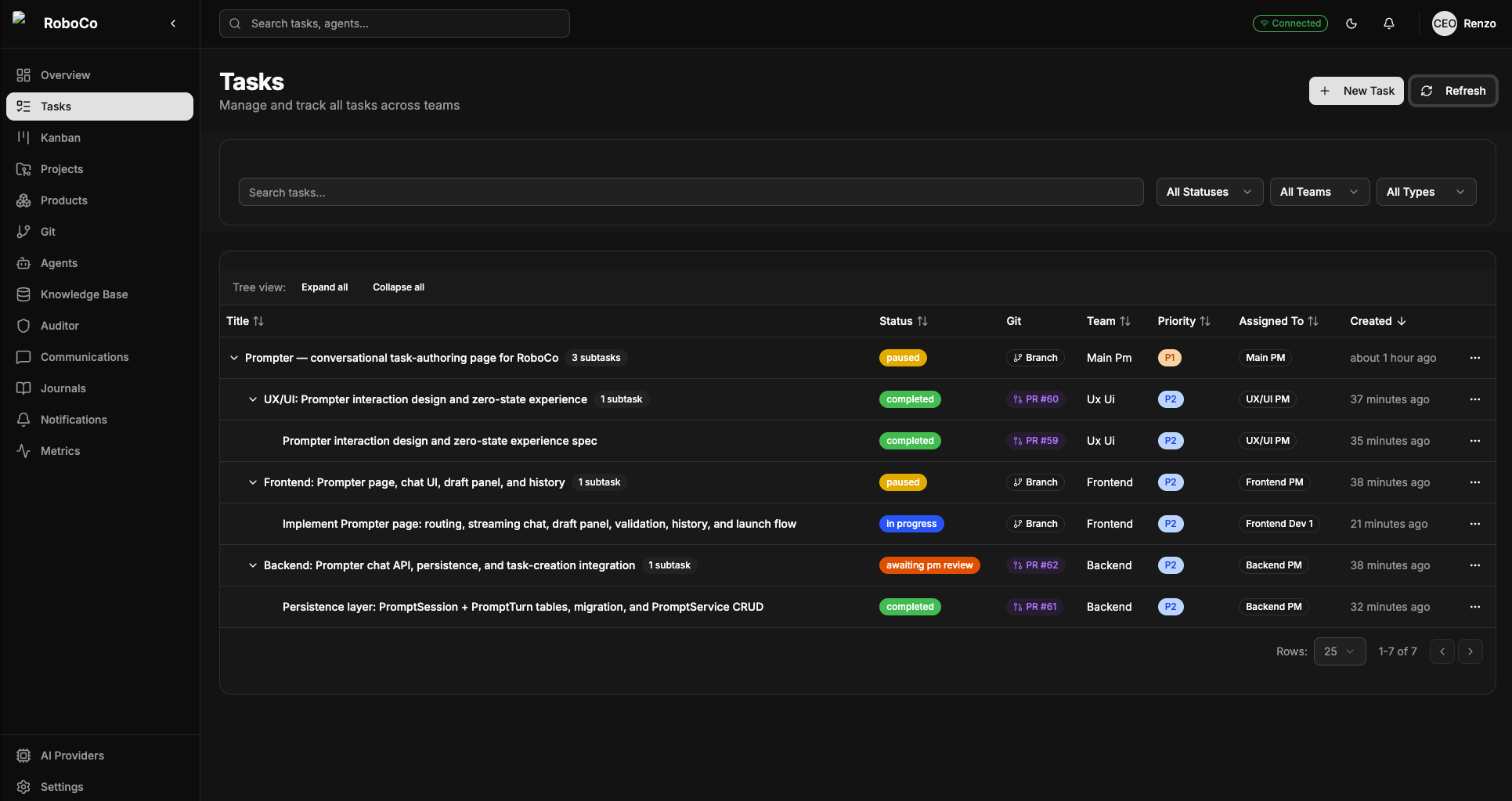
A feature in motion. The parent task fans out to the UX/UI, Frontend, and Backend cells, and each child moves through its own lifecycle — in progress, awaiting review, completed — on its own branch.
Next: It starts with you →